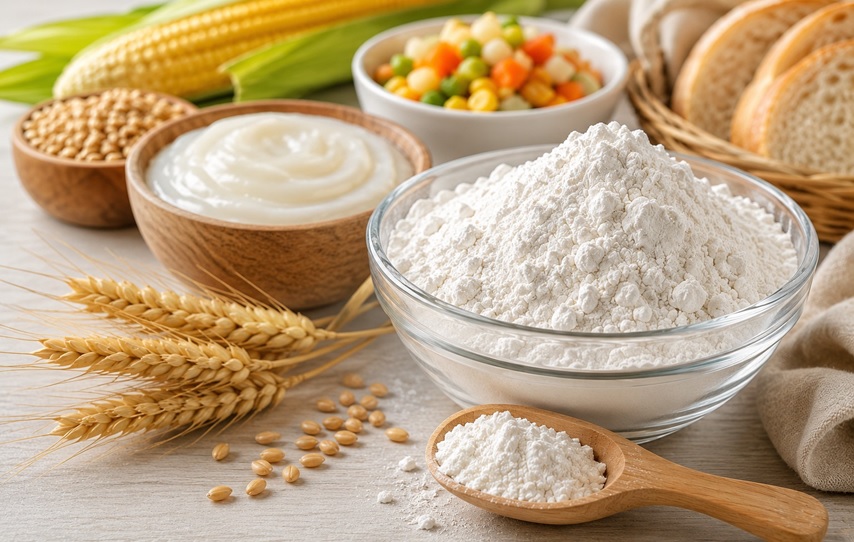
The growing demand for gluten-free products is encouraging food manufacturers to look for ingredients that combine regulatory compliance with reliable technological performance. Developing a successful gluten-free formulation is not simply a matter of replacing conventional flour or wheat-based ingredients. Manufacturers also need to maintain the desired texture, structure, stability and overall quality of the finished product.
In this context, gluten-free wheat starch can be an interesting ingredient for a variety of food applications.
To explore different wheat-derived ingredients and solutions for food applications, manufacturers can visit Sacchetto Starch’s wheat derivatives range.
What Is Gluten-Free Wheat Starch?
Wheat starch is obtained by separating the starch fraction from the other components of wheat. In gluten-free applications, the starch undergoes a specific purification process designed to remove the gluten-containing proteins.
The resulting ingredient can be used in gluten-free formulations when it meets the applicable regulatory requirements and the finished product complies with the relevant limits for gluten.
According to the Codex Alimentarius standard for foods for special dietary use for people intolerant to gluten, products labelled as gluten-free must contain no more than 20 mg/kg of gluten. This makes careful control of both the raw material and the production process essential.
Why Is Wheat Starch Useful in Gluten-Free Products?
Gluten plays an important role in many traditional food formulations, particularly in baked goods. It contributes to structure, elasticity and the ability of dough to retain gas during baking. Removing gluten can therefore create technological challenges for manufacturers.
Starches can help address some of these challenges by contributing to the texture and structure of the finished product. Depending on the formulation and processing conditions, gluten-free wheat starch can help manufacturers achieve specific characteristics while remaining compatible with gluten-free recipes.
Its properties can be particularly useful when it is combined with other flours, starches and functional ingredients.
Applications of Gluten-Free Wheat Starch
Gluten-free wheat starch can be considered for a range of food applications. Bakery Products
Bread, biscuits, cakes and other baked goods are among the applications where starch can play an important role in the formulation.
In gluten-free baking, achieving an appealing texture can be particularly challenging. The right combination of starches and other ingredients can help manufacturers develop products with the desired structure and consistency.
Pasta and Cereal-Based Products
Starch can also be incorporated into gluten-free pasta and other cereal-based formulations. Depending on the recipe and manufacturing process, it can contribute to the texture and performance of the final product.
The choice of ingredient and its proportion in the formulation must, of course, be adapted to the specific characteristics required by the manufacturer.
Sauces, Creams and Desserts
Starches are widely used in formulations where viscosity, consistency and stability are important. Gluten-free wheat starch can therefore also be evaluated for applications such as sauces, creams, desserts and other prepared foods.
Its suitability will depend on factors such as the desired texture, processing conditions and the other ingredients used in the recipe.
Quality and Gluten Control
For manufacturers working with gluten-free products, the technological performance of an ingredient is only one part of the equation.
Raw-material quality, traceability, process control and analytical testing are all important considerations. Manufacturers must also ensure that their ingredients and production processes are managed in a way that prevents unintended gluten contamination.
The Codex Alimentarius provides an internationally recognised reference for gluten-free food requirements and establishes the 20 mg/kg threshold for products labelled as gluten-free.
This makes choosing a reliable ingredient supplier an important part of the product-development process.
Choosing the Right Wheat-Derived Ingredient
Different food applications require different technological properties. For this reason, manufacturers may need to evaluate several wheat-derived ingredients before selecting the most suitable option for a particular formulation.
Gluten-free wheat starch can offer an additional option for companies looking to develop or improve gluten-free products while maintaining specific texture and processing characteristics.
For further information about international requirements for gluten-free foods, the Codex Alimentarius standard for foods for special dietary use for people intolerant to gluten provides an authoritative reference.
Conclusion
The development of gluten-free foods requires more than simply removing gluten-containing ingredients. Manufacturers must also consider texture, structure, stability, processing performance and consistency from one production batch to another.
Gluten-free wheat starch can be a versatile ingredient in this context, with potential applications ranging from bakery products and pasta to sauces, creams and other prepared foods.
As demand for gluten-free products continues to grow, carefully selected and properly controlled ingredients will remain an important part of developing formulations that meet both regulatory requirements and consumer expectations.
